"Trademark vs Copyright: What's the Difference Under Indian Law?"
By Advocate Aksheeta
"Trademark and copyright protect different things under Indian law. Here's how they differ in scope, duration, registration, and enforcement, with examples."
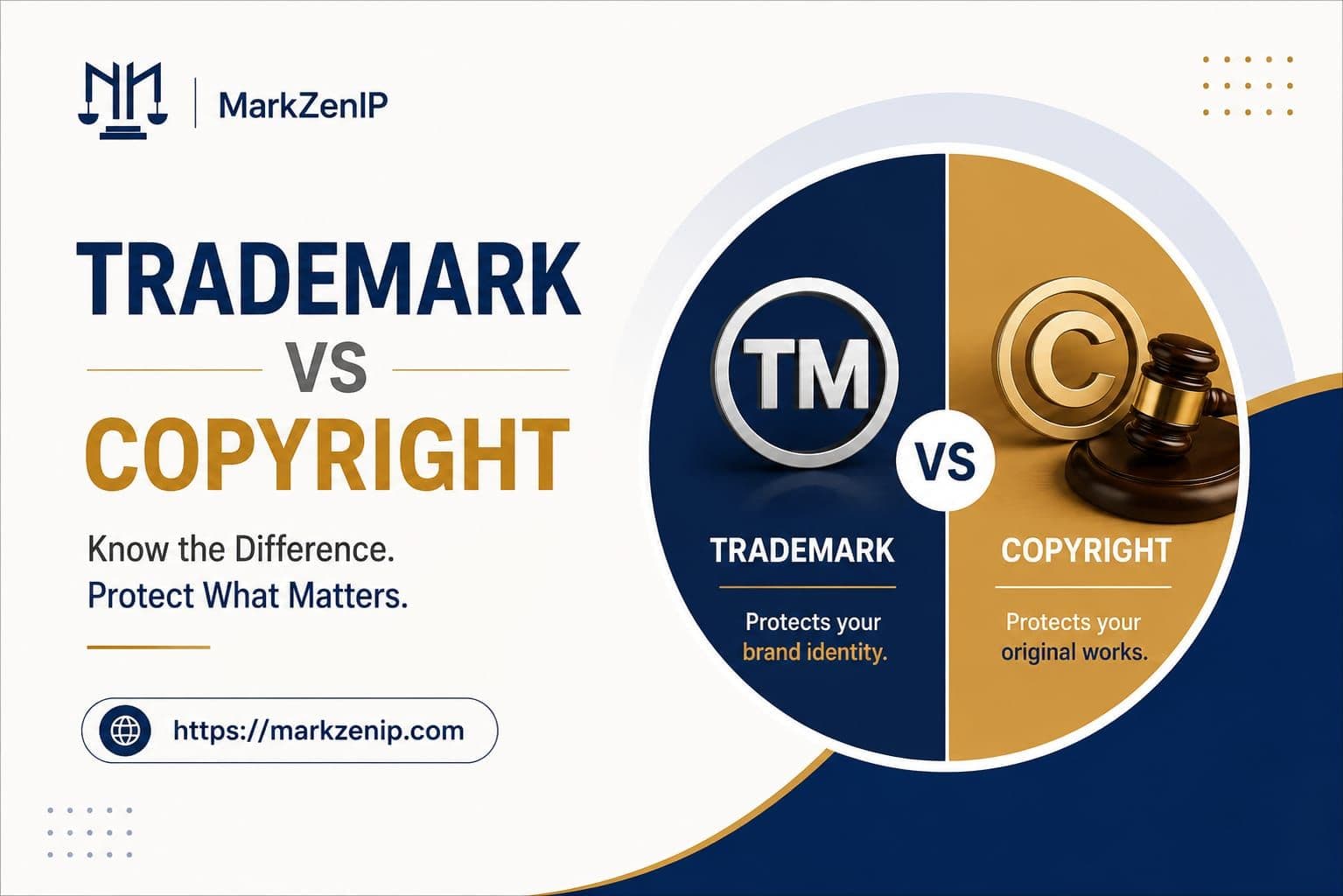
Trademark vs Copyright: What's the Difference Under Indian Law?
If you ask a business owner regarding the measures that will protect their brand name, their response will most likely be trademark protection. On the other hand, if you question someone about what protects a recently published article, their answer will probably be connected to copyright. However, these two concepts are often mixed up and, in some cases, lead to confusion.
Trademark and Copyright are the two most common types of intellectual property, and the fact that they are often mistaken means that some legal aspects are not well-defined. In India, copyright and trademark protection laws are entirely different, meaning that the procedures for registering a copyright and a trademark, and the periods for which they are valid, are not the same. This article aims to highlight the differences between trademarks and copyrights, identify the similarities, and explain how to differentiate between the two, and what to do when you want to register a trademark.
What Is a Trademark?
A trademark is a distinguishing mark that differentiates the products or services of one enterprise from the other. The trademark may be in the form of brand names, slogans, logos, any sound, or a particular packing of the commodity or service. The main purpose of a trademark is that when a buyer sees or hears it, they are assured of the origin of the product/service.
Trademarks in India are governed by the Trade Marks Act, 1999. Trademark registration is not compulsory as unregistered trademarks also provide common law protection to the proprietor against trademark infringement, passing off, and bad faith. However, registered trademarks provide more benefits to the proprietor, such as statutory protection and provides a lesser burden of proof in trademark infringement cases. Moreover, a registered trademark grants exclusive rights to the proprietor over the commodity/service enlisted in the register.
What Is Copyright?
Copyright refers to the exclusive statutory rights relating to original works of authorship including literary works, artistic works, music, films, sound recordings, computer software, and other similar works. Copyright does not protect ideas, names, and short phrases but protects the expression of an idea embodied in a work once it is put into some tangible form.
Copyright in India is governed by the Copyright Act, 1957 and differs fundamentally from trademarks in that it is automatically granted upon creation of a copyrightable work and no formal registration is necessary for its protection, although registration of the copyright with the Copyright Office provides better legal recourse in case of a dispute.
Trademark vs Copyright: The Core Differences
| Aspect | Trademark | Copyright |
|---|---|---|
| What it protects | Brand identifiers: names, logos, taglines, sounds, packaging | Original creative works: writing, art, music, film, software |
| Governing law | Trade Marks Act, 1999 | Copyright Act, 1957 |
| Registration | Optional, but strongly recommended for enforceable rights | Optional; protection exists automatically on creation |
| Duration | 10 years, renewable indefinitely | Author's lifetime plus 60 years (60 years from publication for films, sound recordings, and photographs) |
| Symbol used | ™ for unregistered, ® for registered | © |
| Governing authority | Controller General of Patents, Designs and Trade Marks (CGPDTM) | Registrar of Copyrights, Copyright Office |
| Purpose | Prevents confusion in the marketplace over the source of goods/services | Prevents unauthorised copying, distribution, or adaptation of creative work |
| Renewal required | Yes, every 10 years | No, protection simply expires at the end of the statutory term |
Duration and Renewal: Where the Two Diverge Most Sharply
This appears to be the most significant practical difference between the two, and one that can cause the most common misunderstanding. A trademark registration, according to section 25 of the Trade Marks Act, 1999, is valid for a period of ten years. It may then be renewed for further ten-year terms. This process may be carried out an infinite number of times as long as the proprietor continues to renew it. There is a one-year Grace period during which the proprietor may still seek renewal of the trademark. The first six months constitute the surcharge period, while the subsequent six months constitute the restoration period, during which restoration and renewal may be sought under Section 25(4).
A copyright assignment works quite differently, and also has no renewal procedure. The copyright law protects literary and artistic works for a period lasting until 60 years after the death of the author, beginning on the January 1st following his death. Cinematograph films, sound recordings, photographs, and works of government are protected by copyright for a period of 60 years from the date of first publication. Works created before 1970, therefore, have entered the public domain in the year 2011.
Registration: How the Process Actually Differs
Trademark registration involves searching the existing register of trademarks to determine if there is a conflict for the desired classes of goods/services, as protection in India is on a class basis and the applicant needs to specify the classes while filing the application. As per the Nice Classification, there are 45 classes of goods/services, i.e., 34 classes of goods and 11 classes of services. The application form TM-A, when filed, gets examined by the Trade Marks Registry, which may raise objections if any conflict is detected. Once the application is cleared by the registry or the objections are resolved by the applicant, the mark is published in the Trade Marks Journal for opposition by any third party. Once the opposition period (as mentioned in the Trademarks Act, 1999) elapses or the opposition is resolved in favor of the applicant, the mark proceeds to registration.
The copyright registration process is different because the right is acquired even before filing a registration form. Copyright is secured by filing a Form XIV with the work and the prescribed examination fees with the Copyright Office. The copyright registration provides an official record and a certificate that can be used as evidence in case of an infringement dispute. However, registration does not create a copyright. After examination, the work is recorded in the Register of Copyrights.
Ownership: Who Actually Holds the Rights
For copyright, the usual starting point is that the creator has the copyright in the work of authorship, with a few key exceptions. First, works created by employees are presumed to belong to the employer, unless there’s an agreement to the contrary. Second, the situation can also be complex when the work was done by an independent contractor. For example, you commission someone to design a logo for you; if there is no agreement as to who gets the copyright in the logo, the situation can become contentious. Disputes between businesses and their contractors about who owns what copyright in the finalized work are among the most frequent issues we see.
For trademarks, on the other hand, the primary consideration is who files the trademark application first with the relevant government agency (with some limited exceptions). However, in practice, it can be challenging in some circumstances because different businesses may use the same or similar trademarks in different geographic regions or markets, without directly competing with each other.
Enforcement: What Happens If Someone Infringes
Trademark infringement is the use of a mark that is identical or confusingly similar to a registered mark on similar or related goods or services that is likely to cause consumer confusion. The remedies include civil claims for injunctions, damages and an account of profits. There are in some circumstances criminal remedies for counterfeiting under the Trade Marks Act.
Copyright infringement occurs when someone reproduces, distributes, publicly performs, or adapts a protected work without authorization and without a license or exception that covers the use. Available remedies include injunctions, damages, an account of profits, and, in certain circumstances, criminal penalties under the Copyright Act, 1957.
The practical difference in how these disputes tend to play out: Trademark disputes are usually about consumer confusion in the marketplace, so the evidence often focuses on the similarities between the disputed marks. Copyright disputes are about unauthorized use of someone else’s work, so evidence often focuses on access to the original work and whether the two works are substantially similar.
Can Something Be Protected by Both?
Yes, often at the same time, and this is where a lot of confusion occurs. A company logo is a good example, since as a trademark, it allows you to differentiate goods or services in the marketplace. A trademark, then, is a right to use a certain sign, logo, or other insignia that serves the purpose of identification.
On the other hand, logos are considered original works of art, which are automatically copyrighted upon creation, even if they are officially registered trademarks.
Thus, a business logo can yield two rights that are completely independent but co-exist within the same graphics. One is trademark protection for 10 years, renewable upon request. The other is a copyright, which, unless officially assigned to the trademark owner, will stay in the ownership of the designer, or their heirs, for the duration of 60 years after the death of the creator.
That is why design contracts should clearly state the assignment of copyright to the trademark owner, to avoid situations where a business possesses a registered trademark, but the copyright in the design of said trademark (logo, insignia, etc.) remains with the designer.
Frequently Asked Questions
Is a brand name protected by copyright or trademark?
Trademark. Names, short phrases, and slogans are typically not protected by copyright, which protects original works of authorship, but may be registered as trademarks or, in some cases, protected under passing off laws.
Does copyright protect a business logo?
Usually yes, as an artistic work, from the moment of its creation. However, its protection as a trademark, that is, as a unique brand identifier, requires separate trademark registration of the work.
Do I need to register a trademark for it to be protected?
Not necessarily. Unregistered trademarks can sometimes be protected under a common law passing off action depending on the circumstances, but registration under the Trade Marks Act, 1999 provides much better protection. Passing off relies on proving that the goods/service in question have acquired a reputation in the market, which can be challenging. Registration under the Act provides statutory backing for your trademark, which is far more robust than a common law remedy.
How long does copyright protection last compared to a trademark?
The copyright is the author’s exclusive right to the work for his lifetime and 60 additional years. The key difference is that a copyright cannot be renewed, while a trademark can be renewed every 10 years after registration, so it can technically last forever.
Can the same creative work be protected by both trademark and copyright?
Yes. A logo, a distinctive package design, or original artwork created as a brand identifier can be protected by both copyright and trademark laws. Something can be protected by copyright and trademark at the same time, as it demonstrates the uniqueness of the creation for the particular author and serves as a symbol of a specific trademark.
Which government body handles trademark and copyright registration in India? Trademarks are managed by the Controller General of Patents, Designs and Trade Marks (CGPDTM). On the other hand, copyright registration falls under the Copyright Office, where the Registrar of Copyrights is the one who handles them. Both these intellectual property rights are handled by the Department for Promotion of Industry and Internal Trade.
Conclusion
Trademark and copyright address different concerns. The former deals with the protection of the image or the means by which a customer identifies a company or product, whereas the latter refers to intellectual property or the work created by a company or an individual. This nuance is essential because it dictates the registration process, duration of protection, ownership, and legal remedies available if any unauthorized use occurs.
For most corporations, the importance of both trademarks and copyrights cannot be overemphasized. This is evident in the simultaneous registration of some of the assets discussed above. In addition, protection of certain works may require multiple types of intellectual property.
Discuss this topic with our team
Share a brief outline of your matter and we will connect you with the relevant practice group.
Contact MarkZenIP